

As utility-scale solar and energy storage deployments continue to accelerate across North America, developers are increasingly evaluating whether to build hybrid or co-located photovoltaic (PV) and battery energy storage system (BESS) facilities. While the two architectures may appear similar on the surface, they introduce significantly different operational, control, and SCADA requirements.
At Nor-Cal Controls, we’ve engineered SCADA and plant control solutions for both configurations and have seen firsthand how project design decisions impact integration complexity, operational flexibility, and long-term performance.
What is a Hybrid PV+BESS Site?
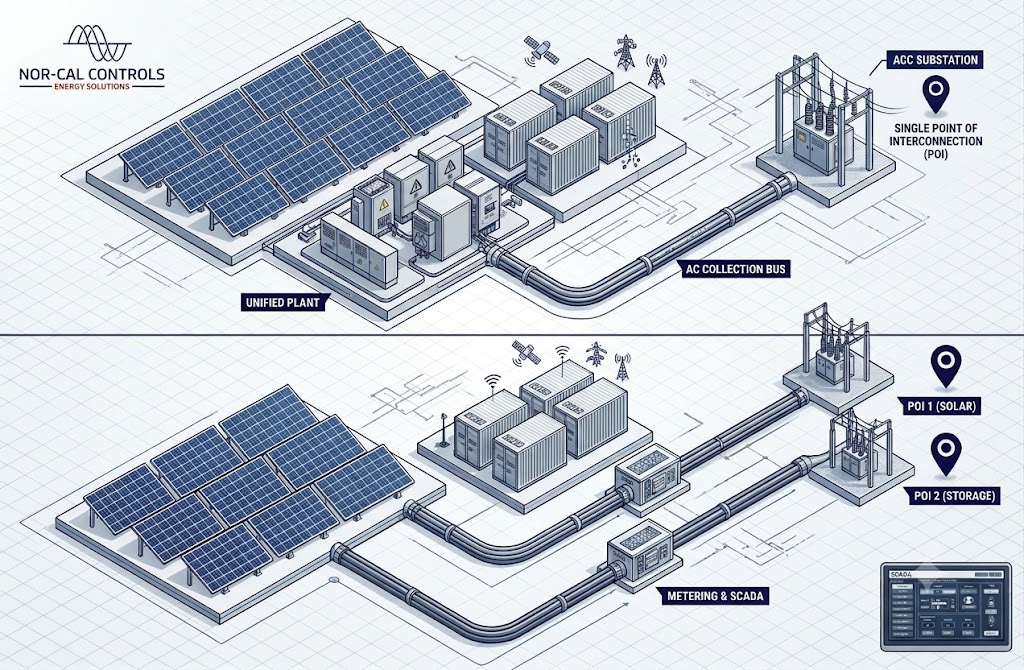
A hybrid site integrates the PV + BESS systems behind a common point of interconnection (POI). The PV plant and BESS operate as a single generating resource from the utility’s perspective. This is most common where BESS is added to an existing PV site as either a DC Coupled or AC Coupled resource. It’s most cost-effective to use a DC Coupled BESS unit if the site is being built simultaneously with the PV units. The Inverter can be selected to integrate with the BESS units. However, if an owner or developer wants to add BESS units to an existing PV plant, using an AC Coupled system likely makes most sense, as tapping into the medium voltage bus is likely more cost-effective than replacing all the PV inverters.
In most hybrid configurations:
- PV and BESS share a common interconnection agreement.
- Export capacity is limited by a single POI.
- Plant-level controls coordinate both resources simultaneously.
- Energy may flow directly from PV to the battery before reaching the grid.
Because the facility is treated as one resource, the plant controller must continuously manage solar production, battery charging/discharging, and export limits to maximize revenue while maintaining compliance with utility requirements.
What is a Co-Located PV+BESS Site?
A co-located site places solar and battery facilities at the same physical location but treats them as separate assets operationally and electrically.
Typically:
- PV and BESS maintain independent control systems.
- Each asset may have separate metering and market participation strategies.
- The systems often have independent interconnection rights.
- Battery charging may occur from the grid, solar facility, or both, depending on market and regulatory requirements.
While the equipment may share infrastructure such as roads, communications networks, substations, or collector systems, each resource generally operates with greater independence. This is most common where owners wish to have multiple off takers to take advantage of different ancillary services or market conditions.
Key Operational Differences
1. Plant Control Complexity
Hybrid facilities require a much higher level of coordination.
The plant controller must continuously answer questions such as:
- How much solar generation should be exported?
- How much should be directed to battery charging?
- Is the facility approaching its POI export limit?
- What dispatch instructions have been received from the utility or ISO?
- What state of charge should be maintained for future market opportunities?
In contrast, co-located facilities often allow each resource to operate using dedicated control strategies with fewer real-time dependencies.
For SCADA providers, hybrid projects typically involve tighter integration between: Plant controller, Power conversion systems (PCS), Battery management systems (BMS), Solar inverters, Revenue metering, Utility interfaces.
2. Interconnection Constraints
One of the primary advantages of hybrid projects is interconnection efficiency.
The most common example of this we see within the major ISO regions (CAISO, ERCOT, MISO) is plant owners and developers building or augmenting BESS units at a fraction of the overall POI MW limit. For example, at a 250MW site, we’ve seen anywhere from 100MW to150MW of BESS units added to the system. This seems to be the sweet spot where operators can take advantage of excess PV production to charge the batteries throughout the day, allowing them to extend their generation window by discharging the batteries as PV production ramps down in the evening. Implementing this model can significantly improve project economics but requires sophisticated controls to ensure the combined output never exceeds the permitted export limit. Co-located projects may have separate operational limits and therefore less coordination at the interconnection level.
SCADA Considerations
Data Aggregation and Visibility
Hybrid facilities require operators to view the site as both:
- A unified generating asset
- Two distinct technologies operating together
Deploying the correct hardware and software is critical to building an efficient system. Utilizing a Master Plant Controller (MPC) can allow operations to control multiple generating assets from a single interface and allows for optimal plant operations. The most common MPC Nor-Cal use is a SEL-3555 RTAC. This Hardware specializes in connecting multiple devices, over multiple different protocols, and has the bandwidth to perform high-level controls such as Voltage and Frequency controls. The SEL-3555 RTAC also has an easy interface to the high-side meters (usually SEL-735s), which allows tight controls in the case when IEEE-2800 is required.
The MPC also allows Operators need real-time visibility into:
- Solar generation
- Battery charge/discharge rates
- State of charge
- Curtailment status
- Export limits
- Revenue meter values
- Utility dispatch signals
A well-designed SCADA system must present these data streams in a way that supports both operational decision-making and regulatory compliance.
Performance Analytics
The distinction between hybrid and co-located architecture becomes especially important when evaluating performance.
For hybrid systems, operators often want answers to questions such as:
- How much solar energy was stored rather than exported?
- How much curtailment was avoided?
- What revenue was created through energy shifting?
- How effectively was the battery utilized?
These metrics require integrated reporting across both technologies. While the hardware and software used to develop the SCADA systems for Hybrid and Co-Located sites might look similar, the reporting, alarming, HMI layout, and dispatching of resources internal to the SCADA system is designed differently. As an example, for a Hybrid site, there is likely a single set of PID controls as there is only a single measured value of energy at the POI. However, for a Co-Located site you might have multiple PID controls per resource, therefore requiring multiple Power Plant Controllers (PPCs) that sit under the Master Plant Controller.
Market Participation Considerations
Hybrid projects are increasingly designed around maximizing revenue across multiple value streams.
Depending on the market, operators may:
- Store excess solar production during low-price periods.
- Discharge during peak pricing events.
- Provide ancillary services.
- Support capacity obligations.
- Participate in resource adequacy programs.
Achieving these objectives requires tight coordination between SCADA systems, plant controllers, energy management systems (EMS), and market dispatch interfaces.
Co-located facilities often have greater flexibility to optimize each asset independently but may not realize all the interconnection efficiencies available to hybrid projects. But because of their flexibility, we often see owners taking advantage of variable market conditions where they will charge the BESS resource during low prices per kW and sell energy during high prices per kW. They also have the ability to participate in ancillary services. Examples of this include the Reg Up, Reg Down, Reserve Spin, Non-Spin, ECRS, and Fast Frequency Response services with the ERCOT region. Since these BESS units are not tied to the overall plant production, they can choose to participate in various external services, which might look different with different grid conditions.
The Role of SCADA in Future Renewable Facilities
As renewable projects become more sophisticated, the distinction between generation and storage continues to blur. Whether a project is designed as a hybrid resource or a co-located facility, success depends on reliable communication, accurate data acquisition, intelligent controls, and seamless integration across multiple vendors. Utilizing a Master Plant Controller (MPC) can allow for ease of use and optimal market participation. Understanding the correct hardware is critical for optimizing plant economics.
At Nor-Cal, we design SCADA and controls solutions that provide operators with complete visibility into both PV and BESS assets while supporting utility compliance, market participation, and long-term operational reliability.
With the industry continuing to move toward increasingly integrated renewable energy facilities, robust SCADA architecture is no longer a supporting component—it is a foundational element of project success. Ready to optimize your next solar-plus-storage project? Contact us today to discuss your project needs and custom SCADA solutions.