

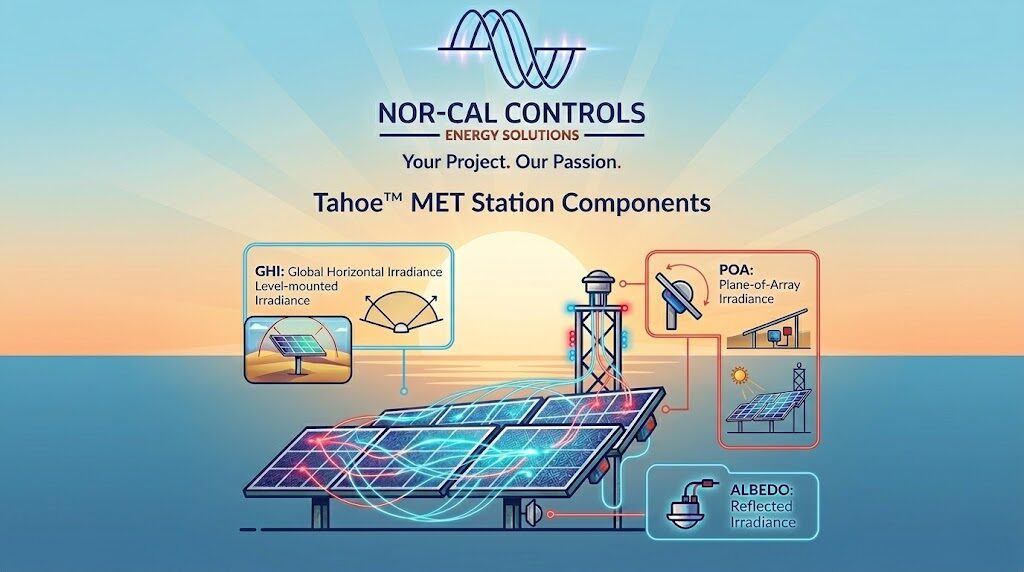
To paraphrase John Denver, sunshine on our sensors makes us happy! Whether you know exactly what pyranometers are needed for your site or need some assistance determining which ones meet your site requirements, Nor-Cal is equipped to customize our Tahoe™ MET Station to measure solar energy up, down, and sideways.
Meteorological stations, or METs, are familiar fixtures on Photovoltaic (PV) sites, but there is a lot of variation when it comes to what and how many sensors are needed, how many stations, and how everything is arranged on the tower and within the array. Focusing on one of the most numerous components of Nor-Cal Tahoe™ METs, let’s look at what each pyranometer does. Simply put, a pyranometer is “a device that measures solar irradiance from a hemispherical field of view incident on a flat surface” (Hukx.com). In a nutshell, it tells you how much solar energy is available at a given spot. Where it gets more complex is all the different ways, angles, and devices we can use to measure that energy. Sometimes “POA” is used as a catch-all for any pyranometer, but strictly speaking, that is only one of many different irradiance measurements.
GHI – Global Horizontal Irradiance
Starting from the top, just about every Nor-Cal Tahoe MET tower has a pyranometer dedicated to measuring Global Horizontal Irradiance. This sensor, usually referred to simply as “GHI”, is fixed in place, with a hemispherical (180°) view angle. It “sees” the entire sky and measures how much solar radiation is reaching the sensor’s location from sunrise to sunset. GHI measurements are composed of both direct and diffuse radiation and are useful for providing a quick reference for the total radiation at a given location. While this data is not used in direct system performance calculations, it is useful for production forecasting and is often required for acceptance tests and audits, and is mandatory to meet Class A monitoring system requirements (IEC 61724-1).
Recommended installation: mounted level, at a height typical of the array, cable exit pointing to the nearest pole (north in the northern hemisphere), sensor south of the tower mast; unobstructed view of the sky; if a lightning rod is installed on the tower, no external surge protection required for cable length < 5m.
DHI – Diffuse Horizontal Irradiance
Sites with bifacial PV modules, to meet optional Class A monitoring requirements, may also have a diffusometer. This is a second, specially shaded pyranometer on the MET tower for measuring Diffuse Horizontal Irradiance (DHI), often referred to by the specific sensor model, i.e., SPN1 or SRD100. DHI is a component of GHI and is the solar radiation that has been scattered in the atmosphere. The accuracy of this measurement can vary greatly due to the shading method of the sensor manufacturer as well as atmospheric conditions.
For comparison, the Delta-T SPN1 uses a computer-generated shadow mask, while the new Hukx SRD100 uses a shadow mask with a Fibonacci lattice. Both manufacturers have a “no moving parts” design and rely on their shadow mask coupled with software to block direct irradiance. Due to the different types of shadow masks, the SPN1 performs better in overcast conditions while the SRD100 performs better in clear-sky conditions. Other manufacturers have options with rotating shadow bands, tracked disk or ball radiometers, and others, each with their advantages and disadvantages.
Recommended installation: mounted level, at a height typical of the array, cable exit pointing to the nearest pole (north in the northern hemisphere), sensor south of the tower mast; unobstructed view of the sky; if the lightning rod is installed on the tower, no external surge protection required for cable length < 5m.
Diffusometers are sometimes co-located with a pyrheliometer (mounted on a sun tracker) to measure DHI and Direct Normal Irradiance (DNI) separately. If GHI and DHI are known, DNI can be calculated, and a direct measurement is not required for Class-A monitoring systems; these separate devices are often deemed unnecessary due to the cost and involved installation/maintenance.
POA – Plane-of-Array Irradiance
Heading out into the array, one will find the ubiquitous POAs. Plane of Array Irradiance is critical for direct system performance calculations, and provides insight into actual panel conditions (shade, dirt, etc.). Often installed mid-array at the end of the row, POA sensors (and RPOAs) are more exposed than tower sensors to potential damage from surges (e.g., lightning strikes). Manufacturers have been stepping up to the challenge and adding enhanced surge protection to their sensors, as well as building new cables and surge protection devices that are more effective, easier to install, and long-lasting even after repeated surge events.
For example, on sites using the new Hukx SR300, which replaces the SR30, Nor-Cal will be using the new industrial cables and SurgeSplitter devices from Hukx to ensure the field pyranometers are protected and operational even in extreme weather conditions. Being able to daisy-chain multiple RS-485 sensors with a single M12 “homerun” cable and provide level 4 surge protection is an exciting prospect! Especially as these new cables can extend much further than previous models without compromising data transfer (lab-tested up to 190 meters). Campbell Scientific is also bringing to market later this year their own Class-A pyranometer, industrial cable, and surge protection device that we are eager to vet for our customers.
Recommended installation: tilted orientation parallel to the PV array, cable exit pointing to ground, external surge protection for cable length > 5m; mounted on a torque tube or purlin to avoid shading.
RPOA – Rear Plane-of-Array Irradiance
In-plane rear-side irradiance pyranometers perform much the same duty as the front POAs, mounted on the back of bifacial PV modules rather than the front. RPOAs, sometimes referred to as IPOAs (Inverted POAs), directly measure the irradiance that is reaching the back side of a PV module. While energy gains from rear-side irradiance can be modest, as low as 5%, it is just as important to have this measurement for the rear as for the front to measure actual panel conditions and monitor panel performance over time.
Recommended installation (a): two sensors, co-located and mounted halfway between the top/bottom edge of the module and the center of the torque tube (mounted to transverse beams/purlins, between modules, or on dedicated stiff-arm), 3 to 5 modules from row end.
Recommended installation (b): two sensors, mounted on the torque tube, sensor 1 mounted 3 to 5 modules away from the row end, 3 to 5 panels between sensors.
ALBEDO – Albedometer
Albedo is the fraction of solar energy reflected by a surface (0 = no reflection, 1 = total reflection). This ratio is ideally obtained using two pyranometers, one facing up, one facing down, mounted together in a clear area away from the array or other potential shading. Anybody who has ever tried to determine the ideal spot for an albedo knows that it can be challenging to find an area within an array that meets these requirements. There are literally pages of complicated equations one can do to determine the ideal mounting height, field-of-view diameter, and distance from any nearby roadways, fences, structures, trees, etc. Fortunately, engineers at Portland State University did some very thorough field measurements of albedo and found that the key area to keep clear is equal to 8.7 times the height of the albedometer (Sailor et al., 2004).
Recommended installation: 1 to 2 meters above surface (1.5m is ideal), horizon as free from obstacles as possible, soil surface should be representative of the area under observation, length of mounting arm should be equal to or greater than mounting height; using the 8.7*H rule, mounting at 1.5m equates to a test surface area with a diameter of 13.05m (approximately 21.4ft radius).
Whether you need a Class A setup to keep your data “shining” or a custom array of sensors to meet specific site requirements, getting the details right is the first step toward a high-performing project. Contact Nor-Cal today to discuss your Tahoe™ MET Station configuration and let our team help make your sensors—and your stakeholders—very happy.