


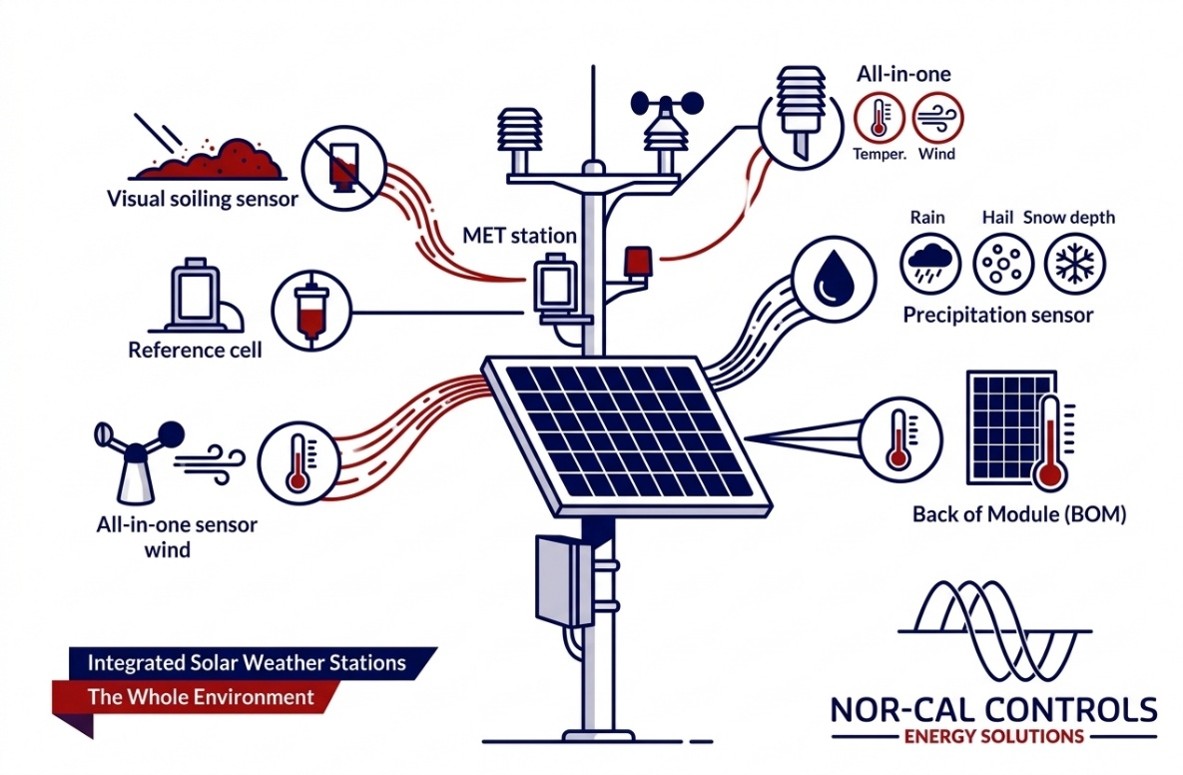
In a prior Nor-Cal post “Sunshine on our Sensors,” we discussed MET sensors that measure the irradiance available at a site, but what about other weather conditions? With our TahoeTM MET stations, we can provide soiling sensors, reference cells, all-in-one sensors, and many other options that deliver valuable information for understanding the environment in which your solar modules are functioning.
Tracking weather data is important to the efficiency of a plant’s operations, and the data can also be utilized to help extend the longevity of the site’s equipment. Weather sensors can be used to determine maintenance schedules, report on how much irradiance solar modules are receiving, and help determine how events such as rain and snow affect the performance of the overall site. To properly design and specify MET stations for each solar plant, it is important to first understand these sensors.
Soiling Stations
Soiling stations are used to measure the rate at which airborne particles such as dust, dirt, and pollen build up on solar modules. These devices are vitally important to determining the efficiency of the panels over time and the cleaning schedules that they will require throughout the seasons. There are two main types of soiling stations: visual and clean/soiled (modules).
Visual soiling stations, such as the Kipp & Zonen DustIQ or the Atonometrics MarsTM, use light transmissions to measure losses. These types of devices have an internal optical sensor that measures the scattered and reflected light to determine the soiling ratio. These are popular because of the ease of use, and they do not require any modules to be used for measurements. They also do not require a washed panel, but that is an option that can be included if desired.
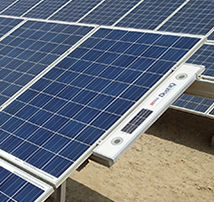
Figure 1 – DustIQ
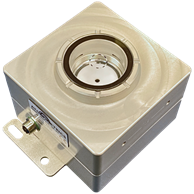
Figure 2 – Mars
Clean/soiled module soiling stations, such as the Atonometrics RDE300iTM (for dual modules) or the Fracsun ARES, use the main solar array modules or a standalone pair of modules to measure soiling ratios. Either option will require two modules, where one is “clean” and the other “soiled.” The clean module will be kept washed while airborne particles are allowed to build up on the soiled module; then, the station can calculate the soiling rate by comparing the clean surface measurements to the soiled ones. These stations are often considered to provide a more accurate comparison to the main modules, but they require a washing station and are generally more difficult to set up and maintain.
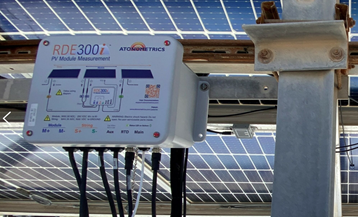
Figure 3 – RDE300i
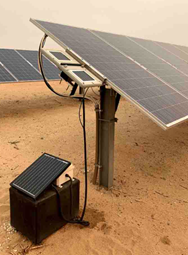
Figure 4 – Fracsun
Reference Cells
Reference cells are used to determine irradiance intensity in the same plane of the array as the site solar modules by using a solar cell of the same or similar material as the main site modules. This method measures solar irradiance and cell temperature to act as a reference point for the modules. The data collected offers insights into the irradiance the modules can convert, as well as how to compensate for the weather without overheating. Most reference cells consist of a small device with a cell built into it that is mounted in the plane of the array, but there are options to connect measuring devices directly into the existing solar modules, such as with the Atonometrics RDE300iTM (for single-module applications).
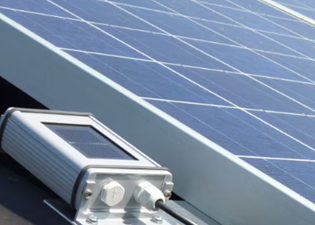
Figure 5 – IMT reference cell
All-in-One
“All-in-one” sensors are made to gather multiple types of weather-related data for a site. Typical data includes precipitation type and quantity, ambient temperature, wind direction and speed, and humidity. Some sensors offer more options than others. To select the correct model, it is important to consider the weather the site is likely to experience as well as to verify the measurement ranges that will be required. The table below shows some of the all-in-one sensor options Nor-Cal can include in our TahoeTM MET stations.
| WS500* -Temperature (-50 – +60°C) -Humidity (0 – 100% RH) -Air pressure (300 – 1200hPa) -Wind direction and speed (0-359.9° & 0 – 75m/s) *To measure precipitation, it is advised to add a tipping bucket | WS600 -Temperature (-50 – +60°C) -Precipitation type, intensity, and quantity (rain/snow, 0.5 – 200mm/h, 0.9 – 15.5m/s) -Humidity (0 – 100% RH) -Air pressure (300 – 1200hPa) -Wind direction and speed (0 – 359.9° & 0 – 75m/s) | WS601 -Temperature (-50 – +60°C) -Precipitation type, intensity, and quantity (rain/snow, 0.5 – 200mm/h, 0.9 – 15.5m/s) -Includes a tipping bucket -Humidity (0 – 100% RH) -Air pressure (300 – 1200hPa) -Wind direction and speed (0 – 359.9° & 0 – 30m/s) | WS800 -Temperature (-50 – +60°F) -Precipitation type, intensity, and quantity -Humidity (0 – 100% RH) -Air pressure (300 – 1200hPa) -Wind direction and speed (0 – 359.9° & 0 – 30m/s) -Radiation (range of 1400W/m²) -Lightning strikes (5 – 10m) |
Precipitation Sensors
All-in-one sensors will not cover every type of precipitation or the associated data that sites can require. Additional precipitation sensors vary depending on the location of the site and the weather that is most likely to occur.
Flood Sensors – There are two common types of flood sensors: pressure and radar. Pressure sensors, such as the OTT PLS 500, use a rod with built-in pressure to tell the flood depth and water temperature. Video sensors, such as the OTT HydroSight, use video monitoring to calculate the flood depth and surface velocity. Pressure sensors tend to be more economical, but selecting the best option for this sensor will be based on the data required. Floods can cause damage to structural supports and increased wear to equipment; tracking flood events provides data to help protect the longevity of the plant.
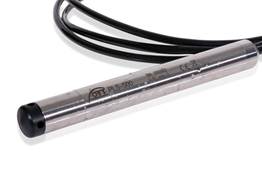
Figure 6 – PLS 500
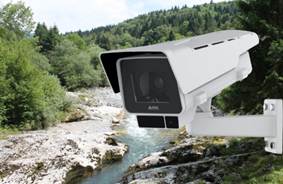
Figure 7 – HydroSight
Hail Sensors – Hail sensors come as an impact pad or a radar. Impact types, such as the Sommer HDI or KISTERS HailSens, utilize a sensor pad that provides hail stone size and frequency of impact data. Radar sensors, such as the WS100, use radar to detect precipitation type, size, and distribution. Hail can damage modules, so it can be important to obtain readings on hail event occurrences and severity to determine if maintenance is required. The preferred data type will indicate which option is best for the site.
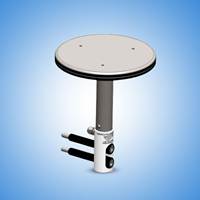
Figure 8 – Sommer HDI
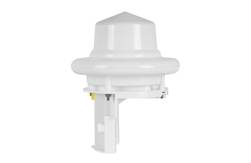
Figure 9 – WS100
Snow Depth Sensors – These sensors, such as the Lufft SHM31, use a beam aimed at the ground to measure snow accumulation with high accuracy. These sensors are vital at sites that are expected to see large snowfalls to determine how snow buildup can affect the modules and how long it takes for the snow to melt. There is not much variety in the types of snow depth sensors or the data points provided by them.
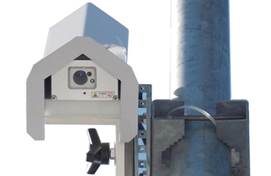
Figure 10 – SHM31
Tipping buckets – Tipping buckets, such as the Texas Electronics TR525, consist of a small “bucket” that empties as water collects to a maximum point by tipping over or using a siphon. They can measure high volumes of precipitation accurately, but they tend to only measure liquid precipitation. They often include a heater for freezing rain or snow conditions. If the all-in-one sensor at a MET station does not provide precipitation data, it is vital to include a tipping bucket to track the impact of weather on the site.
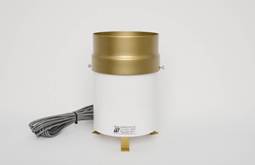
Figure 11 – TR525
BOMs
Back -of- module (BOM) sensors are attached to the back of solar modules and are used to measure the temperature of the modules. Tracking the temperature helps with optimizing operations to the weather and preventing overheating to prolong the life of the modules. BOM factors such as output type, whether it is best for monofacial or bifacial modules, and its temperature range will help determine the make and model that is most appropriate.
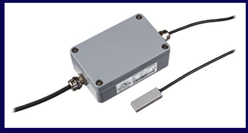
Figure 12 – IMT BOM sensor
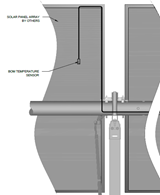
Figure 13 – IMT BOM attached to module
It is easy to see that some of these sensor types offer overlapping data. When selecting the sensors required for a site, it is important to understand the regional environment and the site layout. It may be desirable to err on the side of having more data points for the clearest picture of the site, but it may also be a waste to include more sensors than necessary. If in doubt, standards such as IEC-61724-1-2021 can be used to determine the number of MET stations and the sensors to include per station and for the overall site.
Contact the Nor-Cal team today to evaluate your site’s environmental requirements and determine the right MET station configuration for your next solar project.