


As renewable energy projects continue to evolve, owners and EPCs are constantly looking for ways to reduce system complexity while maintaining compliance with increasingly sophisticated utility requirements. One question we hear frequently at Nor-Cal Controls is:
“Can an SEL RTAC serve as a Plant Power Controller (PPC)?”
The short answer is yes—but with important caveats. The Schweitzer Engineering Laboratories (SEL) Real-Time Automation Controller (RTAC) is one of the most capable industrial automation platforms available. It excels at SCADA communications, protocol conversion, automation logic, and substation integration. In the right applications, it can also function as a Plant Power Controller, especially in specific applications such as sites that require IEEE-2800 control compliance.
However, an RTAC is not a purpose-built PPC, and understanding where it excels—and where it doesn’t—is essential when designing a reliable PV or BESS control system.
What Does a Plant Power Controller Actually Do?
Before discussing whether an RTAC can perform the role, it’s helpful to define what a Power Plant Controller is responsible for. A PPC sits above the inverter or Power Conversion System (PCS) controls and acts as the central coordinator for the entire generating facility. The PPC is also responsible for various control modes, including Active power control, Reactive power control, Voltage regulation, Power factor regulation, Ramp-rate limiting, Curtailment, Frequency response, and Automatic dispatch execution. A PPC performs closed-loop control on the above control functions, ensuring that energy values are met at the Point of Interconnect (POI).
For utility-scale solar & BESS projects, these calculations may occur in sub-20 millisecond control loops. This timing is particularly important as we aim to meet the IEEE-2800 control requirements for Frequency and Voltage controls:
-Reaction Time of less than < 200ms
-Max Step Response Time between 1-30 seconds (TSO specific)
-Dampening Ratio of 0.3 or higher
Without the high-speed execution of a properly designed PPC, meeting these above requirements can prove to be incredibly difficult to meet and can cause significant issues when attempting to pass ISO/Utility testing for commercial operation.
Where the SEL RTAC Excels
The RTAC has earned its reputation because it was designed specifically for electric utility automation. Unlike traditional PLC, the RTAC natively speaks common utility protocols such as DNP3, IEC 60870-5-101/104, IEC 61850, Modbus TCP, Modbus RTU, SEL Fast Message, ICCP, MQTT, OPC UA. For renewable energy facilities, this means one controller can communicate with all the necessary field and substation devices without adding additional layers of protocol conversion that would inherently increase the latency of the network. While a traditional PPC block diagram might look something like:
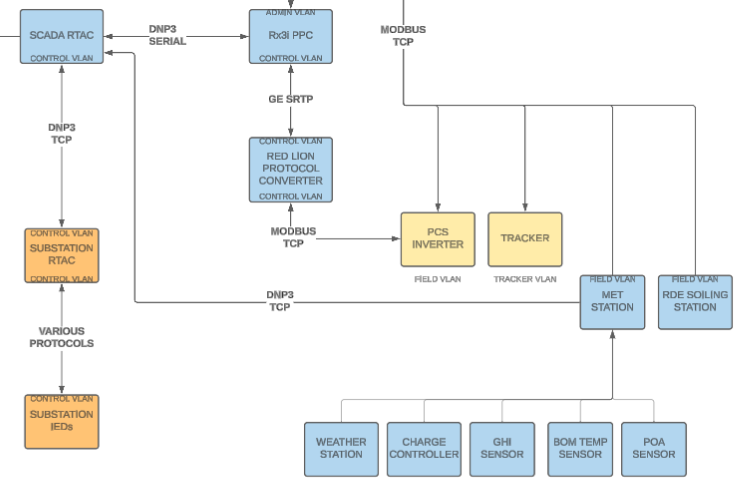
Using SEL-RTAC can reduce this overall device footprint and improve network latency to allow for full compliance with IEEE-2800 control requirements. In the setup below, we eliminate the need for a Substation RTAC connection as meter data comes directly from the SEL-735 high-side meter over PMU speed data (C37.118 protocol). We also eliminate the need for a Redlion Protocol Converter device as the PPC can connect to the PCS directly over Modbus/TCP. This alone can eliminate between 50-100ms of latency, which is a significant reduction in the overall control loop speed.
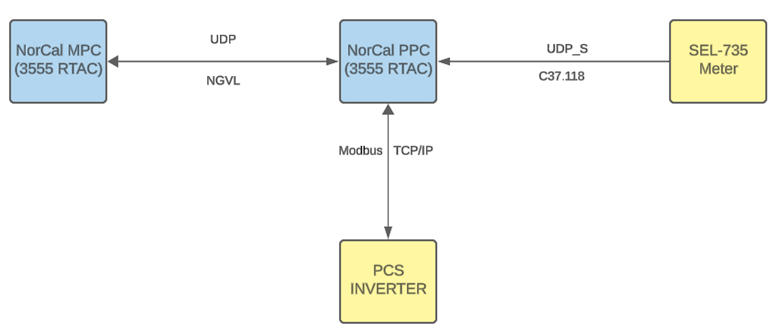
Another advantage the SEL-RTAC provides over a traditional PLC is that the RTAC has an internal protocol (NGVL) which can be used to communicate with other RTACs over high speeds (16 ms). This provides a significant advantage when you have a hybrid or Co-located generation facility with multiple Master Plant Controllers (MPCs), PPCs, or EMS for battery systems. All devices can use the shared NGVL variables map and exchange data with minimal latency. This is increasingly important if the overall site is expected to follow separate dispatch comments for each resource, but needs to follow voltage and frequency compliance at the Point of Interconnect (POI). In a traditional PPC setup, you would need multiple connections between PPCs and MPCs to share these same setpoints and control voltage and frequency.
Where Things Become More Challenging
The distinction between automation and closed-loop control becomes important when discussing PPC functionality. While these algorithms can certainly be implemented within an RTAC, they require significantly more engineering effort than using commercial PPC software specifically designed for closed-loop control. The AcSELerator software, which is used to program RTAC is built well for certain functions; it lacks the robust nature to efficiently build out control logic, such a PID control use and setpoint ramping functions. While it is possible to build these functions within AcSELerator, the development time is often significantly higher than traditional PPC software, and some of the Function Block libraries are not available within AcSELerator. Customer logic is often required to bridge the gap when using an RTAC as a PPC.
Another downside to using the RTAC as the PPC is the functionality of the hardware. Unlike traditional PPCs where certain functions such as internal hardware failover, online downloads, and seamless firmware upgrades are built into the standard PPC hardware, these functions are not yet available within the SEL RTACs. Therefore, careful planning and operational maintenance is needed when working with RTACs on a live system. This might double the engineering or operational time needed to complete a basic task or require unnecessary outages just for simple upgrades.
The hardware is also limited to 250 device connections. For a large PV site (300MW+) or a site with BESS, this might exceed the total field device count for the site. Therefor multiple RTACs or the implementation of Data Concentrators might be needed to communicate for all the field devices.
The Difference Between “Can” and “Should”
One of the biggest misconceptions we encounter is assuming that because an RTAC can perform a function, it is automatically the best platform for that function. Consider a 50 MW utility solar installation. The project requires: 0.95 Power Factor Control based on a voltage-droop curve, basic export limiting, Utility SCADA interface, and meteorological monitoring. An RTAC may be an outstanding choice for this application due to its simplistic nature and limited device connections. However, when comparing costs to other PPCs, the SEL-RTAC might cost double compared to an Emerson Rx3i and might be overkill for a project of this size. If cost is not a factor, other factors such as operational planning might play a larger role.
Now consider a 500 MW hybrid PV + BESS facility participating in CAISO markets. This plant must coordinate the ADS/AGC dispatching from CAISO, resource regulation of voltage and frequency, all with IEEE-2800 control compliance. This project demands far more sophisticated control architecture, and latency between devices must be considered to meet the IEEE-2800 control requirements. In this case, the SEL-RTAC would almost certainly be required to properly coordinate between resources and provide PMU level meter data to the closed-loop control devices. A traditional PLC is likely unable to manage all the separate resources within the 200ms reaction time requirements. However, operations planning must be factored into this setup as well because of choosing to use an RTAC. Updates to RTACs or redundancy considerations are less flexible than a traditional PLC setup.
Our Perspective at Nor-Cal
At Nor-Cal, we don’t believe there is a universal answer to whether an SEL RTAC should serve as a PPC. We prefer to evaluate each project individually. Ultimately, the goal isn’t simply to minimize hardware,; it’s to deliver a control system that is reliable, maintainable, scalable, and compliant throughout the life of the project. The SEL RTAC remains one of the most versatile automation platforms available for electric utility and renewable energy applications. Its communications capabilities, automation flexibility, and proven reliability make it an outstanding component of modern SCADA architecture.
Whether it should also serve as the Plant Power Controller depends on the complexity of the project, the utility’s interconnection requirements, the control functions required, and the owner’s long-term operational goals.
At Nor-Cal, we specialize in designing control systems that match technology to application by not simply selecting the most powerful device available. By combining deep experience in SCADA, renewable integration, and utility communications, we help clients build systems that perform reliably from factory acceptance testing through decades of commercial operation.
As renewable generation and battery storage continue to evolve, thoughtful control architecture will remain one of the most important investments a project team can make. Choosing the right role for the RTAC is an important part of that conversation.
Contact the Nor-Cal team today to evaluate your site’s requirements and determine the right PPC architecture for your next project.